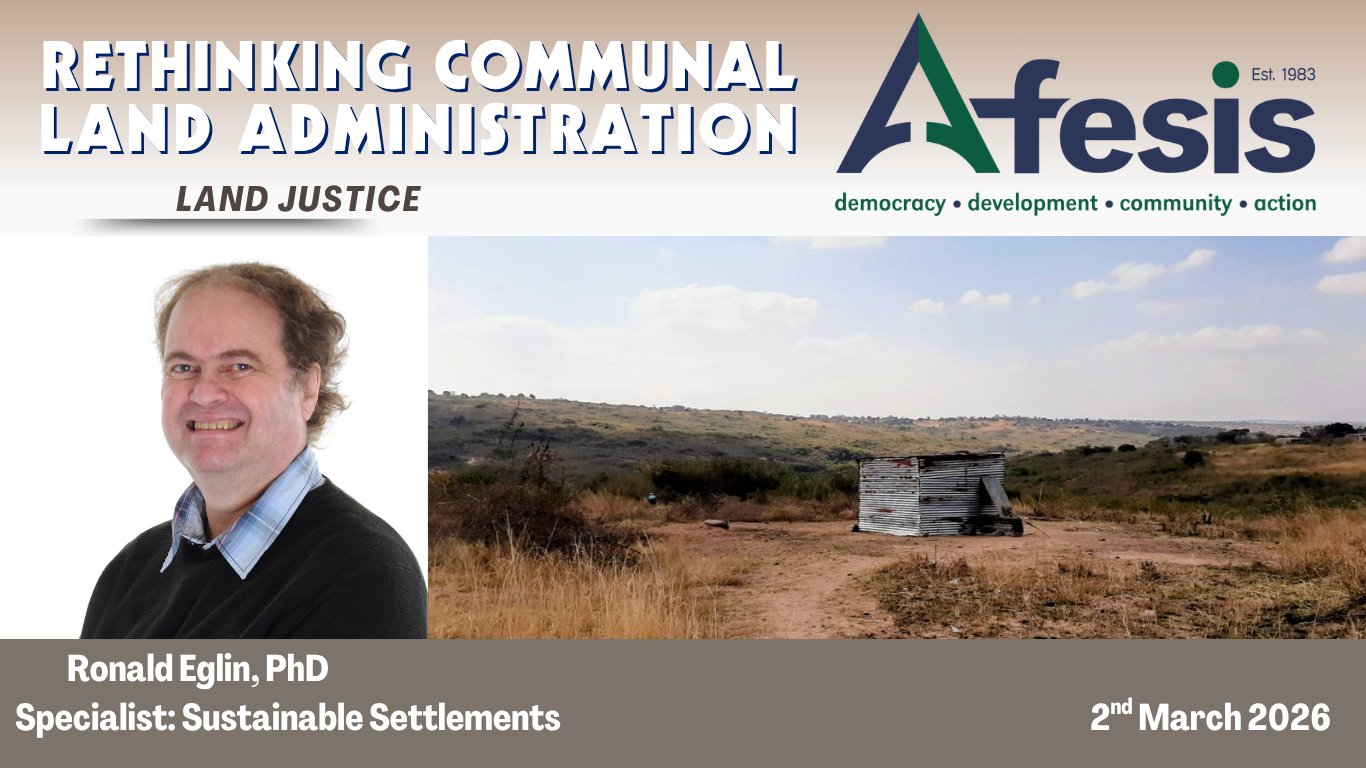
Land Justice: Rethinking Communal Land Administration
Communal land administration represents a foundational, yet underperforming component of South Africa’s land reform agenda. It has significant implications for tenure security, rural development, local governance, and the effective functioning of municipalities.
Across large parts of the country, particularly in former homeland areas, millions of people occupy land under social and customary tenure systems that remain weakly recognised and inadequately supported by formal administrative frameworks. This results in persistent tenure insecurity, limited investment in local economies, and constraints on service delivery and spatial planning.
The core challenge is systemic: existing land administration models are primarily designed around formal ownership and individual title, while the majority of land users in communal areas operate within socially embedded tenure systems. The absence of appropriate, scalable mechanisms to record and manage these rights has created a structural gap between legal frameworks and lived realities.
Afesis’ work in this area is focused on bridging this gap through a systems-oriented, governance-driven approach. The objective is to contribute to the development of land administration models that are:
- Inclusive — recognising social and customary tenure as legitimate forms of land rights
- Functional — enabling practical, locally implementable land record systems
- Accountable — strengthening public institutions responsible for land governance
- Integrated — supporting alignment between land administration, service delivery, and spatial planning
This work aligns with national development priorities and constitutional obligations, particularly in advancing equitable access to land, improving local government performance, and supporting participatory democracy in rural contexts.
Afesis’ approach combines research, policy engagement, and field-based practice to:
- Pilot and refine locally appropriate land administration models
- Strengthen civic agency and community participation in land governance
- Support institutional reform through evidence-based advocacy
- Facilitate dialogue between communities, traditional leadership, and the state
The intended outcomes include:
- Increased tenure security for households in communal areas
- Improved transparency and accountability in land allocation and management
- Enhanced capacity of municipalities and public institutions to support development
- Greater alignment between land rights systems and socio-economic development objectives
Ultimately, this work seeks to reposition communal land administration as a key enabler of inclusive development, rather than a constraint. By building systems that reflect how people actually access and use land, Afesis aims to support more equitable, resilient, and democratic rural and peri-urban communities.