#WriteYourFuture

Home|Urban Planning|#WriteYourFuture

A Return to the Village: How Khwenxurha’s Retirees Are Driving Community Renewal

Ronald Eglin

{This article has been inspired by research conducted by the author as part of his PhD studies. A journal article based on this research can be found here. This article is a hypothetical social media post, written in the year 2034 by and involving fictional characters living in the Khwenxurha communal land area.}

My journey to Khwenxurha, the place formerly known as Mooiplaas, has been nothing short of transformative. It is 2034, the air has a fresh earth smell and you can sense the quiet bustle of a community that has found its footing in a rapidly changing world. Just a few years ago, this network of rural villages, located on communal land approximately 40 kilometres north east of Buffalo City in the Great Kei Municipality, was struggling with immense socio-economic pressures. The region faced the familiar triple threat common across the Eastern Cape: out-migration of its brightest young people seeking work elsewhere, an ageing population with limited resources, and a severe struggle to maintain a viable local economy. However, what I have witnessed on this visit is a profound and moving true revival, concrete evidence of what can be achieved when a community and its municipality decide to work together, focused on a clear, shared vision for the future. The entire process began quietly but decisively in 2026, initiated not through a large national mandate but by a small and determined group consisting of local community leaders, respected elders, and a handful of recently retired professionals who had returned home. They participated in a local planning process that culminated in the production of a set of local socio-spatial development principles which effectively articulated their vision for the area. This was fundamentally a bottom-up, community-grounded approach that placed the power in the hands of the residents, allowing them to define precisely what they valued most about their way of life, their history, and their future.

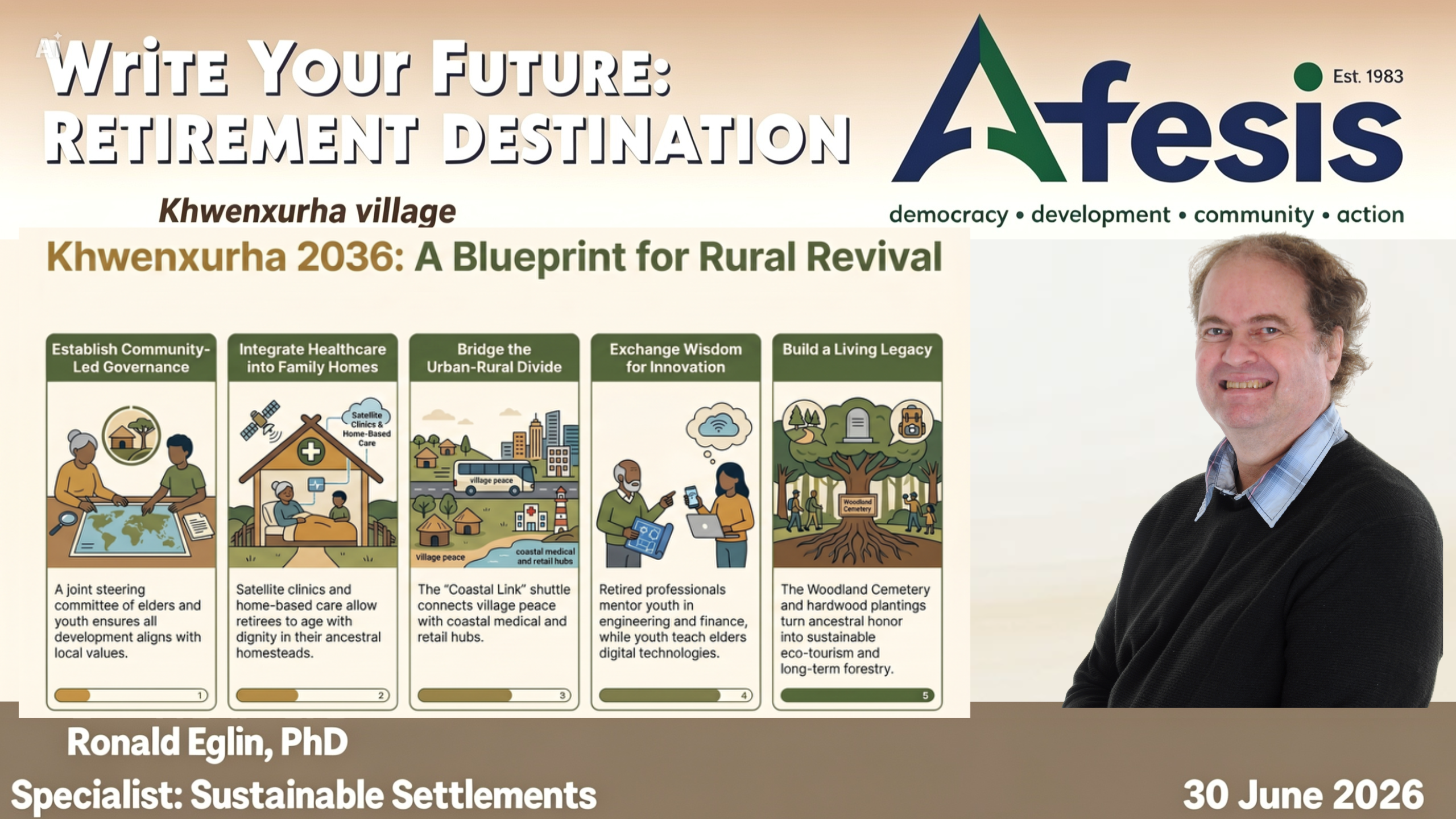
The Great Kei Municipality’s decision to fully support the initiative proved crucial from the outset. “This wasn’t a top-down plan imposed by outsiders; it was a genuine conversation and a partnership built on trust,” explained Siyanda Ngcobo, a young forward-thinking municipal planner who himself chose to move to the area a few years ago, attracted by the innovative planning process being conducted in the area. “The community was clear about what they wanted and what they valued in their environment, and our role was to help them translate that deeply rooted desire into a workable, sustainable strategy that honoured the unique socio-spatial principles of Khwenxurha, rather than disrupting them”. These foundational principles became much more than a static declaration; they evolved into the essential guiding framework for action and accountability. To ensure this alignment remained consistent, the community and the municipality formed a dedicated joint steering committee, which operates as a highly effective model of decentralised governance. This allows for real-time adjustments and swift decision-making in response to emerging needs. Critically, this committee, which includes representatives from the municipality, local villages, respected local elders, active youth groups, and local business owners, continues to meet bi-monthly to meticulously plan for and manage ongoing development initiatives. This constant oversight ensures the region’s socio-economic and spatial development remains strictly aligned with its original, community-driven vision, preventing mission drift and ensuring longevity.

The most striking and successful change, which now stands as one of the central pillars of this rural revival, has been the strategic development of the area as a retirement destination. Crucially, this strategy was not about building a traditional, sterile old-age home complex. Instead, it was focused on creating an environment that fully supports people, who had spent their long working lives in distant cities, to retire back to their ancestral homes and their families with dignity and support. The government and community worked collaboratively to develop a comprehensive, multi-faceted strategy to actively entice these retirees back, ensuring they were fully supported and integrated into the community in their later years. This initiative included the urgent construction of new, modern satellite clinics and specialised hospice centres to provide high-quality, on-site healthcare and humane end-of-life care. Furthermore, the Department of Social Development, working closely with local non-governmental organisations (NGOs), established robust home-based care services, allowing elders to remain comfortably in their family homes while still receiving the professional and dedicated support they require.

The success of Khwenxurha is deeply intertwined with its relationship with the nearby coastal villages of Chintsa, Kei Mouth and Morgan Bay. The villages have forged a collaborative network to provide comprehensive services to the retirees. Instead of competing, they complement each other: Khwenxurha specialises in home-based care and tranquil, rural living, while the coastal villages provide specialist medical services, leisure activities like hiking and fishing, and a broad range of retail options. A reliable, government-subsidised shuttle service, the Coastal Link, now runs three times a day, allowing retirees and others to easily access services and activities across the region. This service was made possible by a crucial infrastructure upgrade where the link road and bridges between Khwenxurha and Chintsa were upgraded, providing a seamless connection between the communal villages and the coastal towns. As one resident told me, “I can live a peaceful, contemplative life here in Khwenxurha, surrounded by my family and my garden, but if I need a specialist appointment or want to enjoy a day at the beach, it’s just a short, comfortable ride away”. This integrated approach provides the best of both worlds, making the entire region a more attractive destination for retirees.

What truly makes this model work is the integration of retirees into the fabric of the community. The village has created multiple avenues for intergenerational connection. The Mentors for Youth programme is a prime example, where retiring professionals volunteer their time to guide young people. I met a retired civil engineer who now helps a group of high school students build and maintain a local water purification system, a real-world project that has transformed their learning experience. “The youth see the elders as a resource, not a burden,” a local community leader explained. “And the elders, in turn, feel a renewed sense of purpose. It’s a symbiotic relationship that enriches us all”. The elders also play a crucial role in the Ukulima Kwempilo movement. This isiXhosa term, which translates to Farming for Life, frames agriculture as a vital part of a family’s livelihood, encompassing not just economic security but also a way of life that provides purpose and physical and mental well-being. This concept is a cornerstone of the Khwenxurha model because it allows the community to maintain its rural-village lifestyle without the unrealistic expectation of becoming a full-scale commercial farming area. The government, through the Eastern Cape Department of Rural Development and Agrarian Reform (DRDAR), has wisely supported this by establishing public-private partnerships to expand community allotment gardens and providing appropriate agricultural extension services. The elders pass on ancestral knowledge to the youth, ensuring traditional agricultural and other practices are not lost while also incorporating modern, sustainable methods. It is about a shared sense of identity and sustenance, not about turning the village into a massive agribusiness.

The development of the Kei Woodland Cemetery is perhaps the most innovative and poignant element of the Khwenxurha project. This eco-friendly cemetery has become a place of profound beauty and peace. It is not just a final resting place but a living memorial. Its concept of shared space for the departed also honours the memory of the original German settlers from the nineteenth century who were buried in the region, adding a further layer of cultural significance. The municipality and community have bigger plans for the woodland cemetery as a key component of their emerging Ancestors’ Tourism initiative. The idea is to provide affordable temporary accommodation and grief counselling services for families visiting their departed loved ones. This brings a continuous stream of new income into the area, supporting local guesthouses and service providers. A local tourism operator, Lindiwe Xaba, remarked: “The idea is brilliant; we’ve taken a deeply rooted cultural practice, honouring our ancestors, and turned it into a reliable source of income. It ensures a continuous financial flow, helping to support every guesthouse and local business here, which ultimately means we are investing in the very future our children and grandchildren will inherit. It’s about honouring those who have gone before, and building for those yet to be born.” This initiative provides a powerful example of how a cultural value can be transformed into a sustainable economic driver, ensuring that the legacy of those who return to Khwenxurha for their final years continues to support the community’s socio-economic development long after they have passed.

This spirit is also the driving force behind the proposed Intergenerational Learning and Innovation Hub, which will take the existing Mentors for Youth programme a step further by formally creating a space for two-way learning. The youth will not only learn from the elders’ wisdom in areas like farming and traditional crafts but will also benefit from their professional skills in management, finance, and logistics, drawn from their varied careers in towns and larger metropolitan areas across the country. In turn, the youth will teach the elders modern skills, from digital marketing to new technologies, ensuring a dynamic exchange that benefits all ages. This hub, alongside the future Living Heritage Trail that will connect the cultural centre, the Ukulima Kwempilo plots, and the woodland cemetery, will solidify Khwenxurha’s position as a national leader in community-led, sustainable development. In addition to the outstanding on-site medical care Khwenxurha provides, the regional health network is also set for a major upgrade, with a new hospital being planned in Chintsa. This promises to provide specialist services and a further sense of security for the area’s growing population of retirees and others.

Beyond the retirement destination, the community and the municipality are also in conversation with local universities regarding the establishment of the Centre for Long-Term Planning. This pioneering academic hub is being spearheaded by Professor Nandipa Ngqobe, a retired academic who brings a wealth of experience in long-term scenario planning gathered from projects across the globe. Her vision for the Centre is to explore and investigate different methods for promoting deep-future thinking that looks 50 to 100 years ahead. Professor Ngqobe explained, “Our core mission is not just to theorise, but to identify the practical, immediate steps we can take today to steer us toward a long-term sustainable and regenerative future. It’s about making a profound choice for the generations to come.” This philosophy is already being translated into tangible action: the planting of indigenous hardwood trees at the woodland cemetery serves as a powerful, practical step. These plantings, which require many decades to mature, are a profound way to get the community thinking about the area’s eventual appearance 50 to 100 years from now, embodying a commitment to future generations. This ambitious project, deeply rooted in the collaborative spirit that has defined this place, will ensure that development remains in harmony with the natural, cultural, social, and economic environment.

It is clear that the transformation of Khwenxurha is not just a passing trend; it is a profound, evolving process of rural regeneration. The regions revival, anchored by its successful model as a retirement destination, demonstrates how deeply rooted cultural values can be leveraged to address socio-economic challenges. By focusing on a community-led approach that integrates retirees as valuable contributors, leverages local partnerships, and honours the past while building for the future, Khwenxurha provides a powerful example of how rural communities can not only survive but organically adapt and flourish in a rapidly changing world.

{This article forms part of the #WriteYourFutureSA series, written from the perspective of someone living in or time travelling to a future date. Contact info@afesis.org.za if you would like to write and submit your own # write your future article.}